For decades, buying property in Nigeria followed a fairly predictable pattern.
You found land.
You saved enough money.
You paid a large amount.
You went through documentation.
You waited.
And eventually, you became an owner.
The problem was not that Nigerians did not want to own property.
The problem was that the process was often built around one assumption:
You need a large amount of money before you can begin.
Technology is beginning to challenge that assumption.
Not by changing what property is.
But by changing how people can access, build and manage ownership.
This is where digital property ownership is becoming increasingly important.
Property ownership is becoming a technology problem
Real estate is physical.
A house is physical.
Land is physical.
A plot does not become digital simply because you put a picture of it on a website.
But many of the activities around ownership can be digitised.
Finding a property.
Verifying information.
Making payments.
Recording transactions.
Tracking ownership.
Managing documents.
Monitoring a customer's ownership journey.
Transferring eligible ownership.
Connecting qualifying ownership information to financial institutions.
The physical asset remains physical.
The infrastructure around ownership becomes digital.
That distinction is important.
The old problem: ownership was all or nothing
Imagine a property worth ₦10 million.
Traditionally, the person who wants to own it has to think about the entire ₦10 million.
If they have ₦500,000, they may still feel like they have nothing.
If they have ₦1 million, they may still be waiting.
If they have ₦2 million, the property may already have become more expensive.
The result is a frustrating cycle:
Want to own → cannot afford the whole property → save → property price changes → save more → wait again.
This is one reason property ownership can feel permanently out of reach.
Technology can introduce a different starting point.
Instead of asking only:
“Can you afford the whole property?”
We can ask:
“Can you begin building ownership?”
This is the idea behind economic ownership
NairaPacket calls this economic ownership.
Economic ownership describes a documented economic and contractual interest in a real property.
On NairaPacket, that interest is evidenced by legal documents and recorded on the NairaPacket Ownership Ledger. (NairaPacket)
The important part is that the underlying asset remains real property.
It is not a crypto token.
It is not blockchain tokenisation.
It is not simply a promise that someone will eventually give you something.
The ownership structure is tied to a specific verified property and documented through the relevant agreements and records. (NairaPacket)
From saving for property to building property ownership
This changes the role of small contributions.
Suppose someone wants to own a property but cannot afford the entire asset today.
With a gradual ownership model, they can begin with an amount they can afford and continue building.
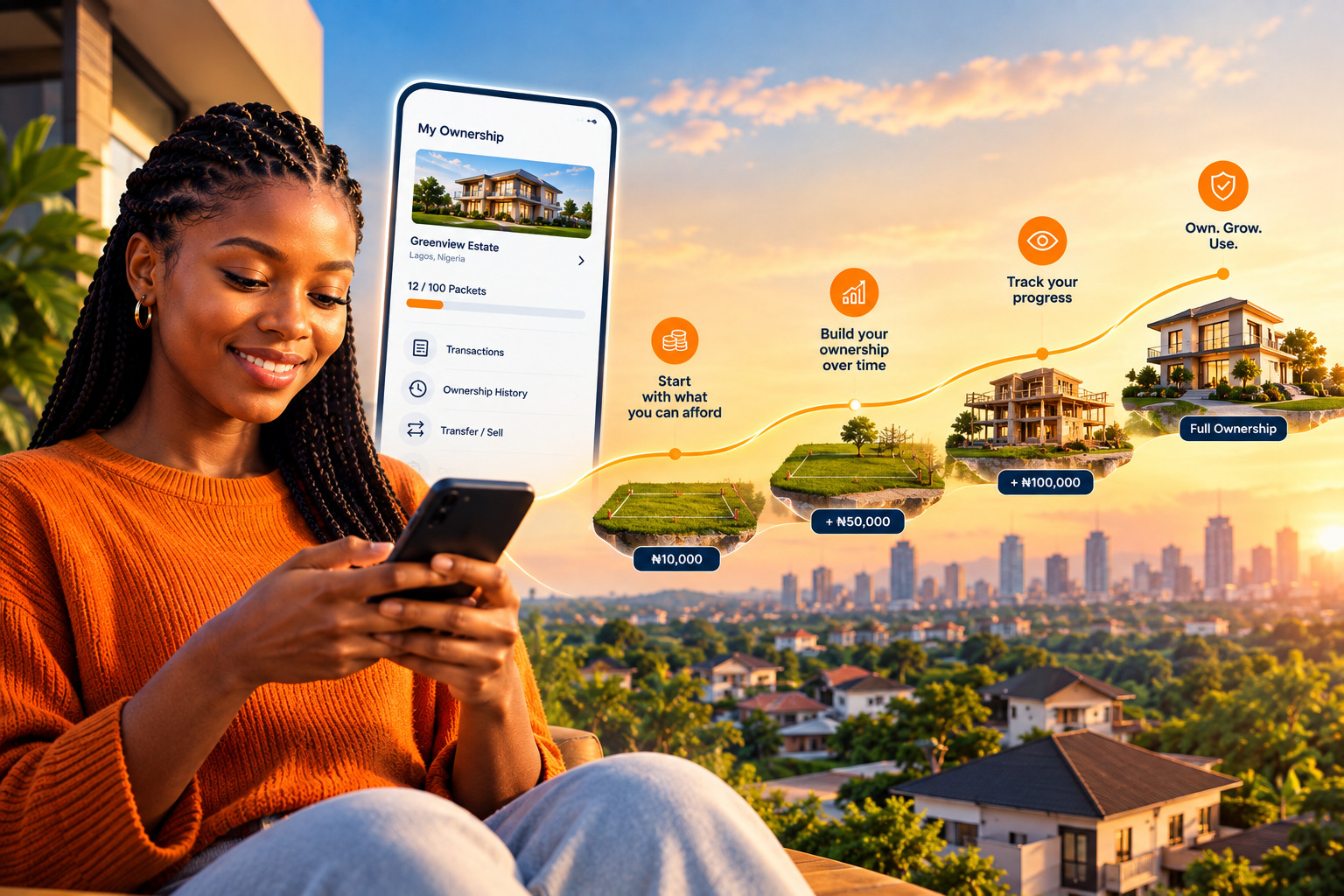
NairaPacket allows ownership to start from ₦10,000, with customers able to add more over time and track their ownership digitally. (NairaPacket)
That creates a different journey:
Start → Own → Grow → Use
Instead of:
Save → Save → Save → Hopefully buy someday
The difference may appear small.
It is not.
When a contribution becomes an ownership position, the customer can see that they are building something.
Technology does not remove the need for trust
This is probably the most important part of digital property ownership.
Making property accessible is not enough.
Making ownership trustworthy matters just as much.
A digital platform can make buying property easier.
But if the underlying property is not properly verified, technology has simply made a bad transaction faster.
That is why property technology needs to start with the asset itself.
NairaPacket's current ownership model uses a six-layer documentation structure:
- Master Estate Title Documents
- Inventory Purchase & Allocation Agreement
- Non-Encumbrance Undertaking
- Economic Rights Assignment Agreement
- Lawyer Verification Letter
- NairaPacket Ownership Ledger
These layers are intended to provide evidence and traceability around the ownership position. (NairaPacket)
The lesson is simple:
Digital ownership should not mean less documentation.
It should mean better access to the documentation and records that support ownership.
The ownership record matters
Imagine two people own property.
Person A has several paper receipts, WhatsApp messages and scattered documents.
Person B can open an app and see:
- The property
- Their ownership position
- Their transaction history
- Their ownership records
- Their eligible transfer options
- Their available ownership actions
The underlying property may be equally real.
But the second ownership experience is much easier to manage.
This is one of the biggest opportunities in property technology.
Turn ownership from an event into a digital relationship.
Ownership does not end after purchase
Traditional property technology often focuses heavily on the moment of sale.
A customer finds a property.
They pay.
The transaction closes.
But ownership can last for decades.
During that period, the owner may want to:
- Track what they own
- Add more ownership
- Transfer eligible ownership
- Pass ownership to family
- Access relevant documentation
- List eligible ownership for sale
- Request credit using qualifying ownership
NairaPacket is designed around this longer ownership journey. (NairaPacket)
That is why we describe the experience as:
Own. Grow. Use.
Technology can connect ownership to finance
This is where property technology and fintech begin to overlap.
A person can have financial information with a bank.
They can also have ownership information with a property business.
Historically, those records may exist in completely separate systems.
What happens if qualifying ownership can be connected to participating financial institutions?
That is one of the areas being developed within the broader AtomAfrica infrastructure.
NairaPacket is the consumer property ownership and distribution network.
AtomAfrica provides the infrastructure around it.
Through AtomCredit, qualifying ownership can be connected to participating financial institutions for credit evaluation.
The financial institution still determines eligibility, underwriting, pricing and terms.
Ownership does not automatically become collateral.
The important change is that ownership information can become more visible and connectable to the financial system when the relevant requirements are met.
From financial inclusion to ownership inclusion
This is where the story becomes bigger than real estate.
Africa's fintech revolution has made it increasingly easier to participate in formal financial systems.
People can open accounts.
Send money.
Receive payments.
Pay bills.
Run businesses digitally.
But financial participation is not the same thing as asset ownership.
A person can be financially active for years without building a meaningful ownership position.
The next question is therefore:
How do we help financial participation translate into economic ownership?
That is the problem NairaPacket is working on.
Ajo already understood the idea
Nigeria does not need to be taught the principle of small contributions becoming something bigger.
We have had it for generations.
Ajo.
Esusu.
Adashe.
Cooperative savings.
People contribute small amounts regularly to achieve things that would be difficult to achieve individually.
The innovation is not the habit.
The innovation is what happens when technology connects that habit to real property ownership.
NairaPacket's Circle model is built around this idea, allowing families, friends and cooperatives to contribute together while maintaining individual ownership positions. (NairaPacket)
In other words:
The technology is new.
The behaviour is not.
Why this matters for young Nigerians
Young Nigerians are entering adulthood in a property market where prices can feel increasingly disconnected from income.
Waiting until someone has enough money to buy a complete property may not always be the most accessible starting point.
A progressive ownership model gives someone another option:
Start with what you can afford.
Build gradually.
Track the progress.
Continue when you can.
The objective is not to make people feel like they are buying something they cannot afford.
It is to create an ownership path that corresponds more closely to how people actually earn and save.
Why this matters for Nigerians in the diaspora
The same problem appears differently for Nigerians abroad.
Someone living in the UK, United States, Canada or elsewhere may want to own property in Nigeria.
But distance creates additional challenges.
How do you identify a property?
How do you verify the documentation?
How do you monitor payments?
How do you know what you own?
How do you manage the ownership relationship without constantly travelling?
Digital infrastructure cannot eliminate every risk.
But it can make the ownership process more visible and manageable.
That is one reason digital property ownership has potential beyond Nigeria's local market.
This is where 35°N's thesis becomes relevant
NairaPacket's broader technology story sits within AtomAfrica.
AtomAfrica is currently listed by 35°N Ventures as a portfolio company. 35°N describes Atom Africa as providing affordable, modular and flexible banking software to financial institutions, helping them improve infrastructure, introduce new products and services and expand financial inclusion. (35°N Venture Studio)
35°N's broader Money thesis is also about building infrastructure and tools that can help financial institutions become more inclusive and unlock new opportunities and revenue streams for businesses and people. (35°N Venture Studio)
That connects naturally to the problem NairaPacket is solving.
If financial infrastructure helps people move money, ownership infrastructure can help them build something with that money.
That is the bridge.
NairaPacket is the ownership layer
NairaPacket is not trying to become a bank.
It is not trying to replace property developers.
It is not trying to make every financial decision itself.
Its role is narrower and more useful:
Help people build, see and manage real property ownership.
A customer can choose a verified property.
Start from ₦10,000.
Build ownership over time.
See the ownership position on their phone.
Manage eligible ownership actions.
And where qualifying ownership can be considered by a participating financial institution, use that ownership information as part of a credit request. (NairaPacket)
The bigger infrastructure story
NairaPacket began with a simple consumer question:
How can more people become property owners?
But solving that question exposed a much bigger infrastructure problem.
Property businesses need better ways to manage ownership.
Customers need better ways to see and manage what they own.
Financial institutions need better connections to economic ownership information.
That insight helped lead to the broader AtomAfrica infrastructure model:
Banking → Economic Ownership → Credit
NairaPacket represents the ownership side of that journey.
AtomAfrica builds the infrastructure around it.
35°N's involvement in AtomAfrica places that work within a broader venture-building thesis focused on solving real problems through better tools, systems and execution. (35°N Venture Studio)
The future of property ownership may not look like the past
The future does not necessarily mean replacing the traditional property market.
Land will still be land.
Houses will still be houses.
Legal documentation will still matter.
Property verification will still matter.
But the way people enter ownership, track ownership and interact with ownership can change.
That is what technology makes possible.
The biggest change may be a simple one:
Instead of seeing property ownership as something that happens only when you can afford the entire asset, we can begin to see it as a journey that can be started, recorded and built over time.
That is the idea behind NairaPacket.
From contributions to ownership.
From saving for property to building property ownership.
From money moving through the financial system to money helping people own something real.
And that is why the next chapter of African fintech may not only be about payments.
It may also be about ownership.
NairaPacket
Own. Grow. Use.
Don't have NairaPacket App installed yet?
Download now and start your property investment journey on-the-go
Join the Discussion 0
Share your thoughts and connect with our community
Leave a Comment
Your thoughts matter to us and the community
Comments (0)
No comments yet
Be the first to share your thoughts!